2026 holiday shipping prep for Hawaii, Alaska, and Puerto Rico
Holiday orders to Hawaii, Alaska, and Puerto Rico need their own preparation plan. Here is what to set up in October, November, and December, and what to review once the season ends.

Most peak season preparation follows a mainland US checklist: forecast demand, stock inventory, and book capacity. Orders to Hawaii, Alaska, and Puerto Rico need a few extra steps. Their send-by dates arrive earlier, peak price increases fall hardest on long-distance parcels, and weather can pause air lift during the busiest weeks.
International Bridge has operated non-continental lanes for more than two decades. The plan below breaks preparation into four stages, timed to this year’s calendar: Thanksgiving falls on November 26 and Christmas on a Friday.
The preparation plan at a glance
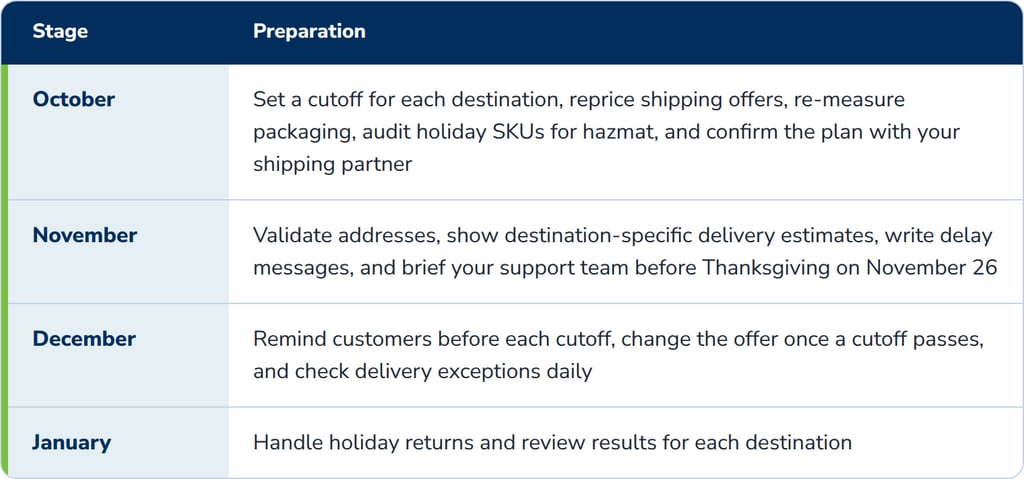
October: set the plan
1. Set a holiday shipping deadline for each destination. For delivery by December 25, the Postal Service recommends sending Ground Advantage packages to Alaska, Hawaii, Puerto Rico, and US territories by December 16. That date is one day earlier than for the mainland US (USPS 2026 holiday dates). Military send-by dates follow in mid-October, and the 2025 Ground Advantage date for military addresses was November 4. Set your own last order date a few days ahead of your shipping partner’s last induction date, and publish separate dates for Hawaii, Alaska, Puerto Rico, and military addresses.
2. Reprice non-continental shipping offers. The Postal Service’s temporary peak prices apply from October 4, 2026 to January 17, 2027 (USPS notice). TransImpact found the sharpest increases on the lightest packages moving the longest distances. In its analysis, Ground Advantage prices for 0 to 3 lb parcels in zones 5 to 9 rose 57.1% over last season. EasyPost estimates that residential demand surcharges from the two largest private parcel networks rose about 22% to 23%. Recheck free-shipping thresholds and flat rates for these destinations before holiday promotions go live, so an offer does not lose money on your longest lanes.
3. Re-measure holiday packaging. Since July 12, 2026, the Postal Service divisor for dimensional weight has been 139 instead of 166, so large, light boxes bill at a higher weight (Stamps.com summary). Check billable weight on gift boxes, bundles, and kits, and move items that tip into a higher weight into smaller packaging.
4. Audit holiday SKUs for hazmat. Perfume, nail polish, aerosols, and lithium batteries are common holiday items that fall under hazmat rules. Since July 12, a $7.50 handling fee applies on Priority Mail and Priority Mail Express, and a $50 noncompliance fee applies to packages that fail the rules. Ask your shipping partner how these fees are billed on your account. Parcels to these destinations depend mainly on air lift, where restricted items face stricter handling. Flag these SKUs in your system so they are declared at label creation.
5. Confirm the plan with your shipping partner. Before November, get written answers to four questions:
What are the 2026 last induction dates for Hawaii, Alaska, Puerto Rico, and military addresses?
Which peak price changes apply to non-continental lanes, and from which dates?
How is air capacity planned for December volume?
How will you report weather or capacity delays, and how are held parcels handled?
If you ship with International Bridge, the IB team can go through all four with you before November. The team draws on IB’s experience on these lanes since 2003, including how weather and air capacity affect delivery to remote areas each December.
Contact us to talk it through.
November: prepare the customer experience
6. Validate addresses before the label. Puerto Rico addresses need the urbanization identifier, covered in 3 things e-commerce sellers must know. For Puerto Rico, check the urbanization identifier before the label is printed, when a correction costs least. Many Alaska addresses receive mail only at a PO Box, covered in shipping to PO Boxes. Military addresses follow their own format. Clean up saved customer addresses for these destinations before the order surge.
7. Show destination-specific delivery estimates. A checkout that shows mainland US delivery dates to a customer in Honolulu or Anchorage sets a promise December transit may not meet. Configure estimates and holiday messaging by destination. If you ship through a shipping platform, set them where your rates are configured. See how IB connects to the platforms you already ship from.
8. Write delay messages in advance. Winter weather can ground flights into Alaska, and the Atlantic hurricane season stays open in Puerto Rico until November 30. Prepare a short site banner and customer email for weather or capacity delays. Say that orders are still accepted, that delivery may take longer, and where to track the parcel.
9. Brief your support team. Give agents the cutoff date for each destination, the expected transit time, and the delay message. Answers to Hawaii, Alaska, and Puerto Rico customers should match what the site and emails say.
December: run to the cutoffs
10. Remind customers before each cutoff. Send reminders a few days ahead of each destination’s last order date, by email and on site. Non-continental customers need them earlier than mainland US customers.
11. Change the offer once a cutoff passes. After a destination’s cutoff, stop promising holiday delivery there. Point customers to gift cards, or state clearly that the order will arrive after the holiday.
12. Check delivery exceptions daily. Review tracking exceptions for Hawaii, Alaska, and Puerto Rico orders each day, and contact customers early when a parcel is held.
January: close out and learn
13. Plan for holiday returns. Returns from these destinations travel the same long lanes back to the mainland US. Extend return windows for holiday orders past January 17, when the Postal Service’s peak prices end, and offer exchanges or store credit alongside refunds. For low-value items, compare the return label cost with the item’s value, since a refund without a return can cost less. Put return instructions in the box and on the site, and ask your shipping partner how return labels on these lanes are priced during peak.
14. Review results for each destination. Record on-time delivery, delay volume, support contacts, and shipping cost per order separately for Hawaii, Alaska, and Puerto Rico. Those figures set next year’s cutoffs and offers. Retailers shipping with IB can talk these results through with the IB team, who handle Hawaii, Alaska, and Puerto Rico shipments every season.
How International Bridge supports your peak plan
For retailers shipping with IB, peak preparation includes:
• Last induction dates by lane. Ask the IB team for last induction dates for Hawaii, Alaska, Puerto Rico, and military addresses, then set your own cutoffs a few days ahead.
• Help with Puerto Rico addresses. Ask the IB team how to check the urbanization identifier before the label is printed.
• The platforms you already use. IB is available inside shipping platforms retailers already work in, so cutoffs and rates can sit in one place.
• Support for these lanes. Delivery questions on non-continental lanes go to the IB team.
• Access for lower-volume shippers. Box of Savings opens the same network to lower-volume retailers.
• Planning for next season. After the holidays, talk to the IB team about how each destination performed and where to set next year’s cutoffs.
Frequently asked questions
When should retailers start preparing for peak season?
October at the latest. Temporary peak prices apply from October 4, and military send-by dates are published in mid-October. Retailers shipping to Hawaii, Alaska, and Puerto Rico should settle cutoffs, pricing, and packaging before November promotions begin.
How do you prepare holiday shipping to Hawaii, Alaska, and Puerto Rico?
Set a separate cutoff for each destination, reprice shipping offers for peak pricing, validate addresses before the label, and prepare delay messages for weather. These steps sit on top of the standard peak season checklist.
What is the 2026 holiday shipping deadline for Hawaii, Alaska, and Puerto Rico?
For delivery by December 25, the Postal Service recommends sending Ground Advantage packages by December 16. The dates for First-Class Mail, Priority Mail, and Priority Mail Express are December 17, 18, and 19. The Ground Advantage date is one day earlier than for the mainland US.
What should retailers do after a non-continental holiday cutoff passes?
Stop promising holiday delivery to that destination. Offer gift cards, or state clearly that the order will arrive after the holiday. Clear messaging after the cutoff reduces late-delivery complaints.
How can retailers confirm their non-continental peak plan?
Ask your shipping partner for last induction dates, peak pricing, and delay procedures for each non-continental lane, in writing, before November. Retailers shipping with International Bridge can ask the IB team for all of these.
Talk to IB about your non-continental peak plan
The IB team can talk through your cutoffs by destination, your peak pricing, and your address handling for Hawaii, Alaska, and Puerto Rico before November.
Contact us to schedule a call.
Continue reading
• How IB connects to the platforms you already ship from. Where to configure non-continental rates and cutoffs.
• Shipping to PO Boxes: why it matters for e-commerce sellers. Reaching customers who receive mail only at a PO Box.