USPS hazmat shipping rules and non-continental air lanes
Hairspray, lithium batteries and hand sanitizer all classify as hazmat. Here is what a compliant label has to carry, and what changes when the parcel is headed to Hawaii, Alaska, Puerto Rico or a US territory.
Originally published May 25, 2023. Updated October 2026.
USPS hazmat shipping rules and non-continental air lanes
A parcel becomes a hazmat shipment because of what is inside it. The shipper's industry has nothing to do with it. Hairspray, a lithium battery pack, nail polish remover and alcohol-based hand sanitizer all carry a hazardous materials classification, and every one of those sits in an ordinary retail catalog.
When the declaration is wrong, the parcel is refused at tender or pulled from the stream later. On non-continental lanes the second outcome is the expensive one. The parcel has already moved, and the replacement order starts from zero.
What counts as hazmat in an e-commerce parcel?
Hazmat classification follows the material inside the parcel. Categories that appear routinely in retail inventory include:
• Aerosols under pressure, such as hairspray, dry shampoo and spray deodorant.
• Lithium batteries, and the devices that contain them.
• Flammable liquids, such as nail polish, nail polish remover and some perfumes.
• Alcohol-based hand sanitizer.
• Several common household cleaning products.
Packaging and quantity change the answer as well. The same product can require a full declaration in one size and sit under a lighter standard in another. USPS Publication 52 is the governing reference, and it sets both the classification and the packaging standard. It defines nine hazard classes, with separate provisions for limited quantity, consumer commodity, excepted quantity and small quantity materials. Individual items are looked up in the Postal Service Hazardous Materials Table at section 328.
For a seller, the practical consequence is that hazmat starts in the catalog. The classification is fixed long before anyone prints a label.
What does a compliant hazmat label have to show?
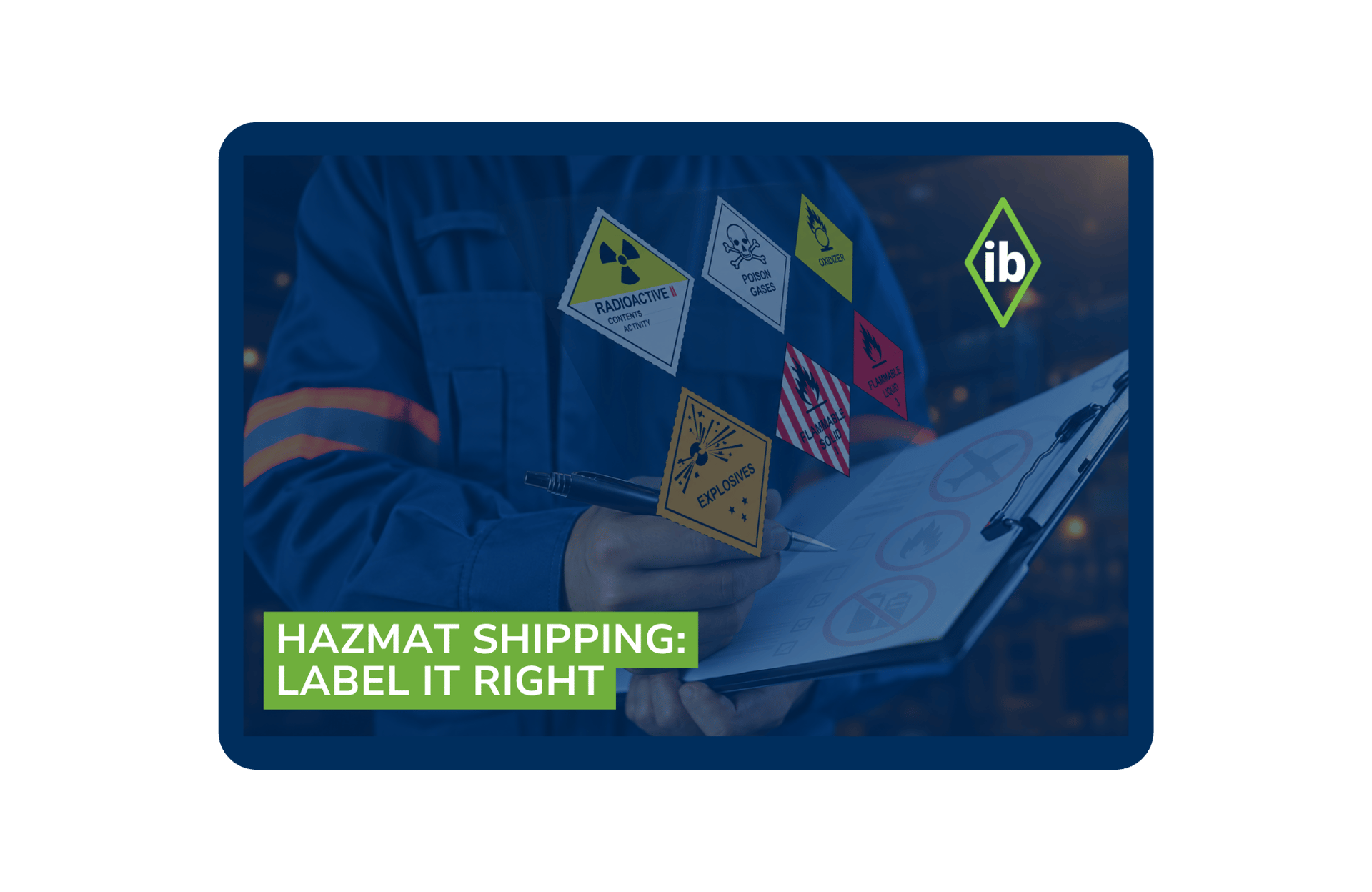
A hazmat parcel carries four things, and Publication 52 specifies each one:
• The DOT hazardous materials warning label for the hazard class, covered in section 325.
• Postal markings that identify the parcel as hazardous to everyone handling it, covered in section 22, marking requirements.
• A content code identifying the hazardous material, submitted with the label request.
• Separate presentation from non-hazmat parcels at tender, covered in section 329.
Marking specifications change between editions. The current edition of Publication 52 is dated August 2026, and it is the version of record. Build the lookup into the shipping process so the answer is current on the day the parcel ships.
A word from Harry Whitehouse, IB Chief Innovation Officer
On the content code, when the requirement came in:
“Mailers are required to enter a code that defines the type of hazardous material within the shipment. Our API users must specify a value, hazmat_contents_code, in the label request.”
In blue, IB's print and ship application developed in-house, that value is set at label creation. It leaves no physical mark on the box, which is why it is the element most often missed. Setting it there means the declaration travels with the parcel from the first scan.
A hazmat parcel also carries more markings on the same face of the box than a standard one: the DOT warning label for the hazard class, the special handling line, and the hazmat marking near the tracking barcode. Placement gets tighter, which gives a point he has made about label placement more force here than it has on an ordinary parcel:
“Carrier operations teams sent us two pictures of label placements that essentially prevent the carrier from scanning the tracking barcode. Without those scans, neither you nor your recipient can see where the package is in the delivery cycle. You might even miss the final delivery scan, because a carrier may not have time to manually type 22 or more characters into a handheld scanner.”
On a non-continental lane that matters more again, because the parcel is already several handling events from home when a scan goes missing. Affixing a shipping label on a package covers placement in full.
What changes when hazmat moves by air?
Publication 52 treats air transportation separately from surface transportation. Part 7 covers air transportation requirements on its own, down to a section headed air transportation prohibitions. The hazard class chapter carries the same split: limited quantity air materials at section 334, and limited quantity surface materials at section 336. An item can qualify under one and not the other, which is why air eligibility is a separate question from whether an item is mailable at all.
On most mainland US lanes a seller never meets that distinction, because a ground option exists and the parcel takes it.
Non-continental lanes work differently. For small parcel e-commerce volume, ocean and ground transit times are too long to serve a customer order. The practical route to Hawaii, Alaska, Puerto Rico, the US territories and military addresses is air, and IB Non-Con runs on established air routes for that reason.
That puts the air restriction directly in front of the seller. An item with no air route has no route at all to these destinations, whatever the label says. Catching it in the catalog costs a product data field. Catching it at tender costs the order.
The definitive guide to shipping to Hawaii, Puerto Rico, and Alaska sets out how the wider non-continental network is built and why transit behaves the way it does.
Military addresses carry their own version of this. Publication 52 gives lithium batteries one packaging instruction for domestic shipments and a separate one for international and APO, FPO and DPO. The same battery can follow a different rule depending on the address it is going to.
Which destinations does this affect?
Every non-continental destination IB serves: Hawaii, Alaska, Puerto Rico, Guam, the US Virgin Islands, American Samoa, the Northern Mariana Islands, and APO, FPO and DPO addresses. Transit to Hawaii, Alaska and Puerto Rico runs 2-5 business days. The Hawaii shipping page, Alaska shipping page and Puerto Rico shipping page carry the detail on each lane.
One distinction is worth holding separately. A hazmat declaration is a safety requirement. A customs form is a border requirement. Puerto Rico sits inside the US customs territory, so a parcel from the mainland US needs no customs form, and the hazmat declaration still applies in full. Sellers conflate the two. They either add paperwork that was never required, or skip a declaration that was.
Where hazmat shipments actually fail
Three failure points account for most of what goes wrong.
1. The seller does not know the item is classified. Product data rarely carries the flag, so the classification surfaces at tender, after the order is picked and packed.
2. The label is built for a lane the parcel is not taking. A declaration that clears a surface network does not clear an air network, and every non-continental parcel is an air parcel.
3. Hazmat and non-hazmat are tendered together. The mix slows acceptance for the whole batch, not only for the declared parcels.
All three are catalog and workflow problems. All three are visible before the parcel moves.
Four checks catch all three:
• Flag hazmat items in product data, at SKU level, so the classification is known before the order is picked.
• Check air eligibility for every flagged SKU, separately from whether the item is mailable.
• Set the content code at label creation.
• Separate hazmat from non-hazmat before tender.
Frequently asked questions
Is hairspray classified as hazmat?
Yes. Hairspray is an aerosol under pressure, which places it in a hazardous materials class regardless of the quantity in the can. The practical implication is that a hairspray order needs a compliant hazmat label and a content code, whatever the seller's category.
Can hazmat be shipped to Hawaii, Alaska and Puerto Rico?
Much of it can, provided the material is acceptable for air transport and the label declares it correctly. These destinations are served by air for small parcel volume, because surface transit times are too long for a customer order. The practical implication is that air eligibility is the first thing to check, before label format. Part 7 of Publication 52 is where that check is made.
Does a hazmat shipment to Puerto Rico need a customs form?
No. Puerto Rico sits inside the US customs territory, so a parcel sent from the mainland US carries no customs documentation. The hazmat declaration is a separate safety requirement, and it applies in full.
What is a hazmat content code, and where is it entered?
A hazmat content code identifies the type of hazardous material in the parcel. It is submitted with the label request, so it is set at label creation and does not appear as a physical marking on the box. In blue, IB's print and ship application developed in-house, the value is passed as hazmat_contents_code.
Where do I check whether a specific item can travel by air?
Start with the Postal Service Hazardous Materials Table at section 328 of Publication 52, which lists items by hazard class. Then check Part 7, which sets the air transportation requirements and the air prohibitions separately from the general mailability rules. The practical implication is that an item can clear the first check and fail the second, so both have to be run before a non-continental order is accepted.
Talk to us about the hazmat items in your catalog
Talk to the IB team about the hazmat items you sell. We will review which of them are acceptable for air transport to the destinations you serve, what each label has to declare, and how the content code is set at label creation. There is no commitment attached to the conversation.
Keep reading
• Definitive guide to shipping to Hawaii, Puerto Rico, and Alaska. The architectural view of how the non-continental network is put together.
• Shipping to US territories operational guide. What changes by territory on customs handling and documentation.
• Affixing a shipping label on a package. Where the label sits on the box, and why placement decides whether the barcode scans.