Shipping label placement: how a misplaced barcode slows every scan
A barcode the scanner can't read is a parcel the network can't track.

Label placement is the smallest step in the parcel journey and a common reason packages stall in transit. A barcode bent over a corner, taped under glare, or printed at the wrong size will not scan cleanly. Automated sorters reject it. Drivers retype the tracking number by hand. The tracking history goes quiet between scan points.
For a network designed around continuous automated sortation, that is the worst place for a parcel to fail. It is also a fix the shipper controls at zero cost.
Why label placement decides scan success
Modern parcel networks route, sort, and track packages through automated barcode scanners at every induction and sortation point. The barcode is the parcel's identity in the system. If a scanner cannot read it, the parcel exits the automated flow and goes to manual handling, which is slower and more error-prone at every step.
The downstream consequences:
Automated sorters reject the parcel and divert it to a manual exception lane.
Drivers type the tracking number by hand on pickup or delivery.
Tracking updates go missing between scan points, so the parcel appears stuck.
The cost compounds. Label and barcode problems are among the most common causes of delivery exceptions, and they are preventable at the source. Tracking gaps then drive “where is my order” inquiries that load up customer support. Operational re-handling and support contact stack on top of the label cost, so the total cost of a single mishandled label sits well above the value of the label itself.
Reading the barcode: a note from Harry Whitehouse, IB Chief Innovation Officer
Carrier operations teams sent us two pictures of label placements that essentially prevent the carrier from scanning the tracking barcode. Without those scans, neither you nor your recipient can see where the package is in the delivery cycle. You might even miss the final delivery scan, because a carrier may not have time to manually type 22 or more characters into a handheld scanner.
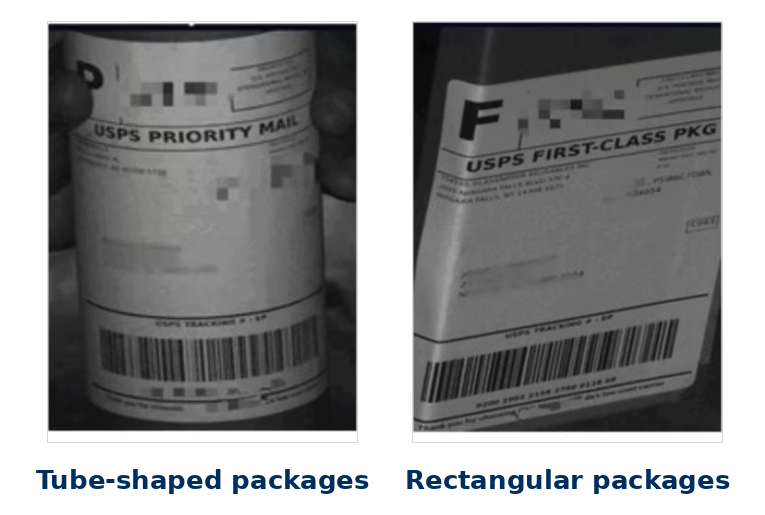
The automatic scan fails because modern barcode scanners need to see the entire length of the one-dimensional barcode on a single planar surface. The readers cannot read around corners. Fortunately, there is an easy fix for both situations.
For tube-shaped packages, rotate the label 90 degrees. Regardless of how the scanner and tube line up, there is always a portion of the barcode shown completely on one plane.
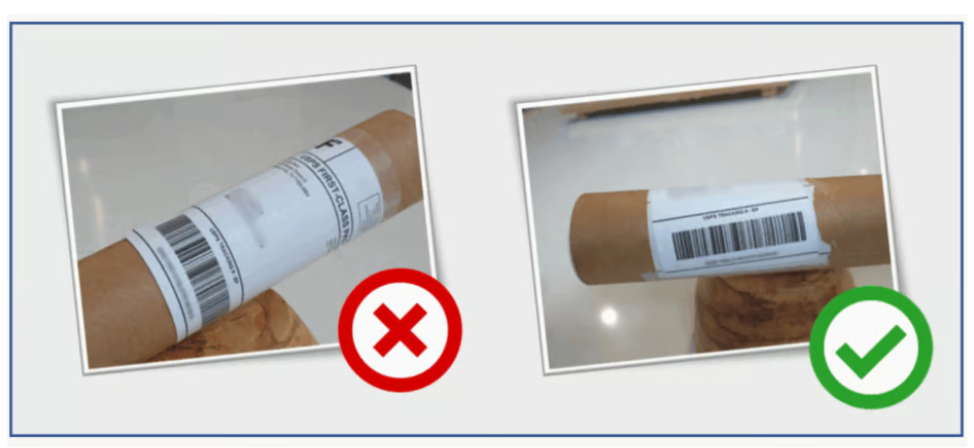
The exposed height of the barcode is irrelevant. Modern scanners only need a small slice of the barcode where the bars are on one plane and visible over the full length.
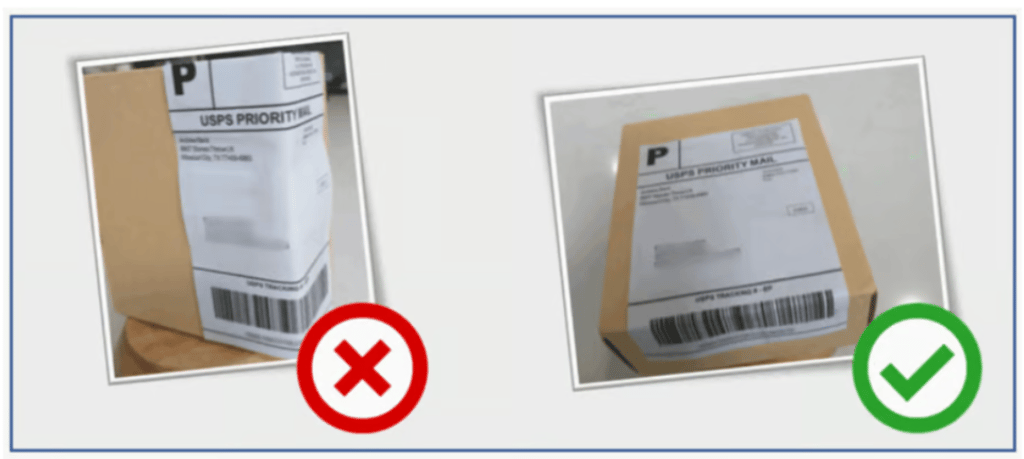
For rectangular packages, rotate the label 90 degrees as well. The barcode still wraps the corner, but in a way that leaves two sections fully exposed and on the same planar surface.
If you regularly ship very small packages, check whether your label provider offers a 4 inch by 4 inch option. That smaller format often makes a real difference on small boxes.
If you are apprehensive about reducing the height of the barcode, a bit of history helps. The original one-dimensional barcodes required generous heights, typically three quarters of an inch, because early operations teams used handheld pen scanners rather than lasers. A pen scanner meant moving a pen-like device from one end of the barcode to the other, and over a few inches your arm naturally travels in a slight arc. The generous height accommodated that arc. The laser scanners used today do not need it.
Print quality matters as much as placement
A correctly placed label still fails if the print is poor. A reliable scan needs a sharp, dark print with no fading, banding, or smudging. Direct thermal labels work for short transit with few touchpoints, but they fade under heat, humidity, sunlight, and abrasion. For non-continental lanes, thermal transfer printing produces a more durable print that survives multi-day transit and multiple handoffs through air capacity and on-island sortation.
Customs declaration placement on territory parcels
Parcels to certain US territories require a customs declaration on the outside of the parcel. Guam, American Samoa, and the Northern Mariana Islands fall in this group, per the USPS Domestic Mail Manual, Section 608. Requirements vary across the other territories, and the US territories and APO/FPO/DPO shipping guide covers the destination-by-destination rules.
When a customs form is required, it sits on the same primary face as the shipping label. A misaligned form creates a second failure point at the same scan. It can obscure the barcode, confuse a scanner with its own scan code, or peel and fold in transit and foul both reads.
Practical rules:
Place the customs form adjacent to, not overlapping, the shipping label.
Keep both labels on a single flat face.
Use one clear pouch for both, or two pouches that do not overlap.
Confirm the form is fully visible from the same handling position as the shipping label.
For shippers running volume to multiple territories, generating customs documentation in the shipping workflow before parcels move reduces label-to-form misalignment downstream. IB Non-Con generates CN22 customs declarations as a built capability for shippers without that step in their own workflow.
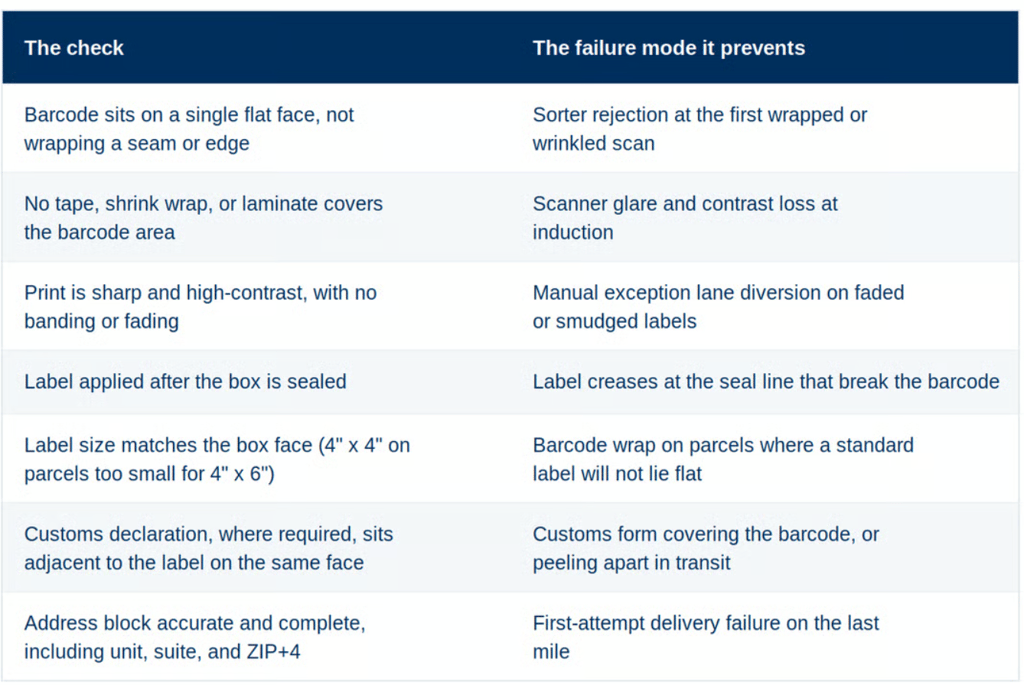
Pre-induction shipper QA checklist
Seven physical-label checks the shipper runs at their own dock before parcels move to carrier pickup. The point is to catch label problems while the parcel is still in your hands, where the fix costs nothing.
Frequently asked questions
Should the shipping label go on the top of the box?
Top placement is the most reliable position because it is the easiest face for automated sorters to read. Side placement is acceptable when the barcode stays fully flat and unobstructed. Avoid placing the label across an edge or seam, since wrinkles in the barcode are a common cause of scan failure.
Is it safe to cover the shipping label with tape?
Covering the barcode with tape is not recommended. Glossy or reflective tape creates glare that interferes with reads, and even matte tape adds a layer that reduces contrast. If the label needs protection from moisture, use a clear matte label pouch over the full label so the barcode surface stays flat and readable.
What size label is best for small parcels?
A 4 inch by 4 inch thermal label is the best fit for parcels too small to carry a standard 4 inch by 6-inch label on a flat face. The smaller format keeps the entire barcode on one surface and prevents the wrap that causes rejection at automated sorters. For mailers and irregular shapes, choose the largest label size that still sits on a single continuous face.
How does label placement affect non-continental shipments specifically?
Parcels moving to Hawaii, Alaska, or Puerto Rico typically pass through more scan events than a continental ground shipment, because the route moves a parcel from truck to air to on-island sortation to last mile. Each additional scan is another opportunity for a marginal label to fail. The gain from correct placement is larger on non-continental lanes than on continental ones.
What print quality is required for a label to scan reliably?
A reliable scan requires a sharp, dark print with no fading, banding, or smudging. Direct thermal labels are sufficient for short transit with few touchpoints, but they fade in heat, humidity, sunlight, and abrasion. For non-continental lanes, thermal transfer printing produces a more durable print that survives multi-day transit and multiple handoffs.
How should a customs declaration be placed on a parcel to a US territory?
The customs declaration sits adjacent to the shipping label, on the same primary face of the parcel. Both must stay fully visible and flat through the scan path, with no overlap covering the barcode or the form's own scan code. Guam, American Samoa, and the Northern Mariana Islands require a customs declaration on parcels from the mainland US. For requirements on the other territories, see the US territories and APO/FPO/DPO Shipping for E-Commerce Businesses shipping guide.
What this means on non-continental lanes
Continental ground parcels see fewer scan events than non-continental parcels. The multi-modal path through air capacity and on-island sortation creates more chances for a marginal label to fail, as the definitive guide to shipping to Hawaii, Puerto Rico, and Alaska explains across all three lanes. A label that scans cleanly at induction can still get rejected at the third or fourth handoff.
For shippers running volume to Hawaii, Alaska, Puerto Rico, or the US territories, label discipline at the source is the highest-leverage operational fix available. After more than twenty years operating non-continental lanes, IB sees one pattern hold. The networks that move parcels predictably are the ones whose shippers eliminate marginal labels before parcels leave the dock.
Talk to IB about a label and induction review for your non-continental lanes.
A short conversation covers your current label specifications, where they sit on your packaging, and the scan-failure patterns IB observes in the lanes you use. We will name what is costing you scans and what changes first. There is no commitment in the conversation.
→ Contact International Bridge
Keep reading
The definitive guide to shipping to Hawaii, Puerto Rico, and Alaska. The full picture across the three lanes and how each is built for predictable scan and delivery flow.
IB Non-Con service overview. How the purpose-built network is structured and what it is built to handle.
Box of Savings consolidation. The route for small-volume shippers to reach IB Non-Con's consolidation economics, which reduce shipping cost by approximately 30% versus standard national carriers.