How shipping transit times are calculated: business days, holidays, and non-continental lanes
When a holiday falls inside a delivery window, business days and calendar days separate. The count runs in business days, from induction to delivery. It shifts on non-continental U.S. lanes, where Puerto Rico keeps its own calendar.

How long a shipment takes and how long it feels are rarely the same number. A carrier measures transit in business days, counted from the first scan to delivery. A customer measures it in calendar days, counted from the moment they click buy. Put a weekend or a holiday inside the delivery window and the two diverge far enough to trigger a "where is my order" ticket on a parcel that arrived right on time.
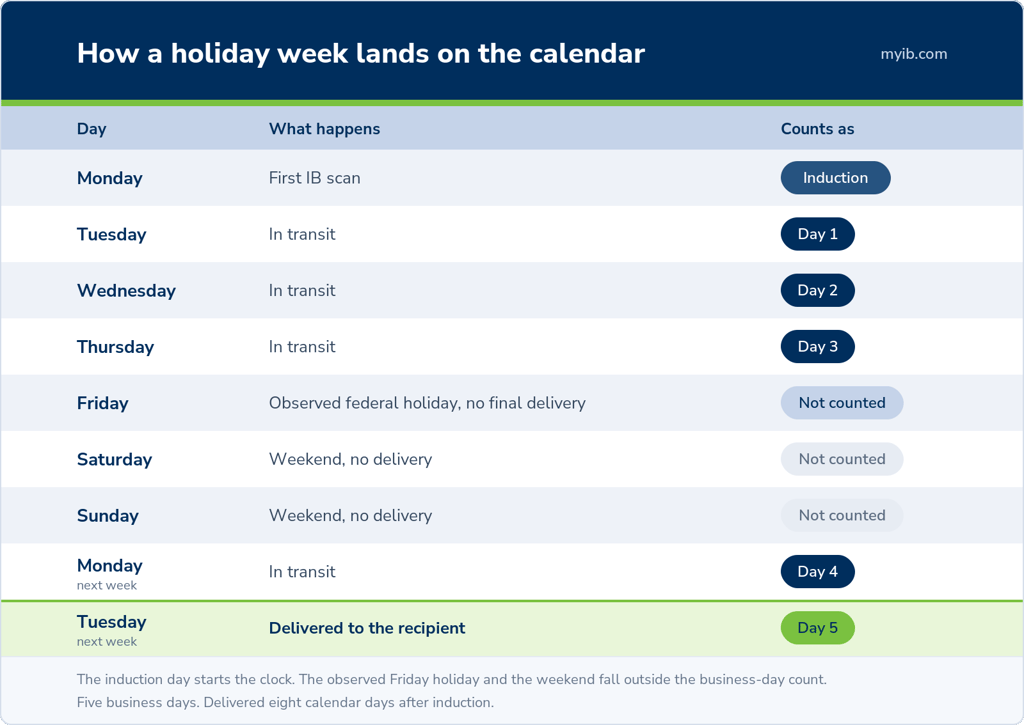
Independence Day is a useful place to start. When the Fourth of July falls on a Saturday, the federal holiday is observed the preceding Friday. That places a non-working day directly against the weekend and creates a three-day stretch with no final delivery before the parcel advances to the recipient. The business-day count for a shipment does not change. The calendar date a customer waits for does.
Transit time is the gap between how movement is measured and how customers read it. IB Non-Con commits to end-to-end delivery within 2-5 business days to Hawaii, Alaska, Puerto Rico, and U.S. territories. Business days are the unit that matters operationally. Calendar days are the unit a customer counts. When a holiday lands inside the window, the two numbers separate, and the date the customer expects is not the date the parcel arrives.
This post explains how the transit window is counted, where holidays enter a non-continental shipment, and why Puerto Rico's calendar needs its own attention. IB has moved parcels through these lanes for over two decades, including every peak the calendar produces, so the examples come from the lanes themselves.
How is shipping transit time calculated?
Transit time is the number of business days a parcel takes from induction to final delivery, excluding weekends and holidays. Induction is the first scan that places a parcel in the network and sets its routing. A business day is a standard operating day, Monday through Friday. Weekends and observed holidays are not business days, so they do not count toward the window, but they still occupy space on the calendar.
A 2-5 business day commitment describes operating days of movement. It does not promise a calendar date on its own. To get the calendar date, start from the induction day and count forward, skipping every Saturday, Sunday, and observed holiday in the window. The more non-working days inside the window, the further the calendar arrival drifts from the business-day count.
A parcel inducted on a Monday with no holidays in the week arrives within a tight, predictable spread. The same parcel inducted before a holiday week carries the same business-day count but lands on a later calendar date. The network performed identically. The calendar did the rest.
Business days vs. calendar days: what is the difference?
Business days exclude weekends and holidays. Calendar days count every day. A shipment quoted at five business days and inducted on a Monday with no holidays arrives the following Monday, seven calendar days later. The two extra days are the weekend, which was never a working day and never part of the business-day count.
Holidays widen the same gap. Add one observed holiday inside that week and the five business days span eight calendar days. Add a holiday that sits next to a weekend, as the observed Independence Day does when the Fourth lands on a Saturday, and the non-working stretch compounds. The business-day count holds while the calendar date moves later.
For a retailer setting expectations, the rule is simple. Measure performance in business days, because that is what the network controls. Communicate to the customer in calendar dates, because that is what they read. The cost-to-serve does not change. The expectation does, and a missed expectation drives a support ticket even on an on-time shipment.
Where do holidays enter a non-continental shipment?
A non-continental shipment moves through four functional legs, and a holiday affects each one through the calendar of whoever operates it. Origin processing prepares the parcel and sets it on its route. Air transport carries it from the mainland U.S. to the destination market, since for small parcels air is the only mode fast enough for e-commerce. Destination processing readies it in-market. Final delivery completes the last leg to the recipient.
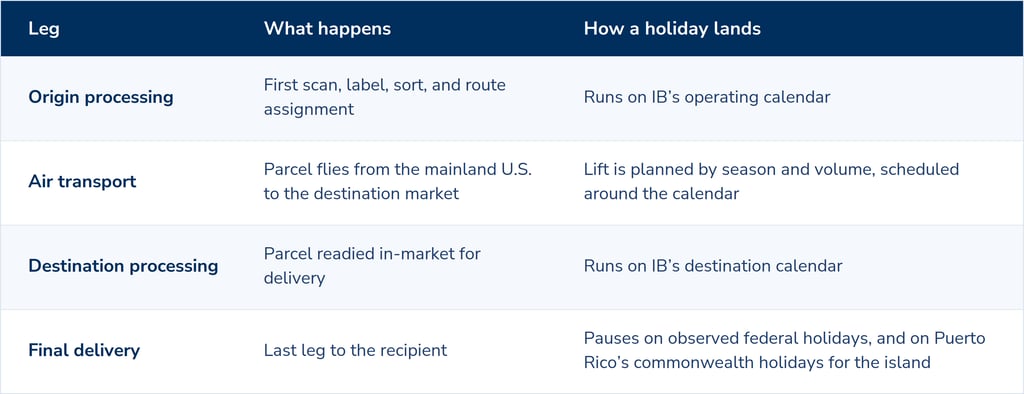
Those legs do not all run on the same calendar. The legs IB operates are governed by IB's own operating calendar and air-lift planning, sequenced through protocols refined over two decades. The final delivery leg follows the delivery calendar of the destination market. When that market observes a holiday, the final leg does not move that day, even when the parcel cleared every earlier leg on schedule. A parcel can finish origin processing, fly, and complete destination processing on time, then wait because the day it is ready for delivery is a no-delivery day.
This is why the architecture matters more than any single number.
Which holidays affect non-continental delivery?
Eleven federal holidays fall each year, and on each one the final delivery leg pauses across every non-continental destination IB serves. Parcels already moving between facilities are not frozen by the holiday. What stops is the last leg to the recipient, so a parcel ready for delivery on an observed holiday goes out the next business day.
Federal holidays also shift when they land on a weekend. A holiday on a Saturday is observed the preceding Friday, and one on a Sunday is observed the following Monday. This rule is set in federal law and published in the federal holiday schedule from the U.S. Office of Personnel Management. Hawaii and Alaska follow the federal calendar. Puerto Rico follows it too, then adds a layer the mainland calendar does not show.
Why does Puerto Rico need its own holiday calendar?
Puerto Rico observes commonwealth holidays in addition to the federal ones, and several fall on dates that are ordinary working days on the mainland U.S. Puerto Rico is a U.S. territory, so shipments to it are domestic, with no customs forms and no duties. Domestic treatment leaves the operating calendar the island's own. That calendar governs the final delivery leg inside Puerto Rico.
Three examples show the pattern. Three Kings' Day, on January 6, is one of the most widely observed days of the year across the island. Emancipation Day falls on March 22. Constitution Day, marking the 1952 Puerto Rican constitution, falls on July 25. None is a mainland working-day exception, so a transit estimate built only on the federal calendar under-counts the days when one of them lands inside the window.
The operational implication is concrete. A retailer planning a Puerto Rico promotion in early January is planning into one of the island's highest-demand and highest-observance windows at once. The federal calendar shows nothing unusual about early January; only the island's local calendar flags the overlap. Accounting for the local calendar is what keeps the Puerto Rico promise as reliable as any mainland U.S. lane.
The performance holds up against that calendar. Across IB Non-Con's Puerto Rico lane, 95% of shipments are delivered within four days, inside the 2-5 business day commitment. For destination detail, see the Puerto Rico shipping page.
How should retailers set delivery expectations around holidays?
Start the count from induction, not from the order date. The clock the network runs begins when the parcel enters the network, which is rarely the moment a customer clicks buy. Order cutoffs, processing time, and weekend orders all sit before induction, so counting from the order date builds in error before the parcel has moved.
From there, four practices keep the calendar honest:
Measure in business days, communicate in calendar dates. Hold the network to the business-day window. Translate it into a specific calendar date for the customer, weekends and holidays already removed.
Map the holidays inside the window before quoting. Check the federal calendar, and for Puerto Rico the commonwealth calendar. A single observed holiday inside the window moves the arrival by a full day or more.
Watch holidays that touch a weekend. An observed Friday holiday against the weekend creates a multi-day stretch with no movement. Build that stretch into the promise rather than finding it afterward.
Plan peak promotions against the local calendar. A Puerto Rico push in early January meets Three Kings' Day. A summer push meets Constitution Day on July 25. Demand and observance often peak together, and lift is planned around exactly these windows.
None of these changes the cost-to-serve or the network's performance. It changes whether the date you promise is the date the parcel arrives. That alignment is what turns consistent transit into a retention advantage. A promised date the customer can count on is one they act on again the next time they order.
Talk through your peak calendar with IB
Holiday windows are where transit-time promises are made or missed, and they are specific to your lanes, your volume, and your cutoffs. Start a conversation with IB about how the federal and Puerto Rico holiday calendars map against your promotional schedule, and how IB plans air lift and final delivery around the dates that matter most to your customers. Get specifics for your operation at myib.com/contact-us.
If you want more context first, three places to read next:
The definitive guide to shipping to Hawaii, Puerto Rico, and Alaska. The architectural view of how the legs are engineered, worth reading to see why each behaves the way it does around a holiday.
Puerto Rico shipping page. The destination detail behind the island's domestic treatment and delivery windows.
Box of Savings. How lower-volume shippers reach the same network and the same transit windows, useful if your holiday volume is seasonal.