What is USPS collect on delivery (COD)?
USPS Collect on Delivery (COD) collects payment from the recipient at delivery and remits it to you. Here are the two label models, the fees and the $1,000 limit, EFT setup, and when COD earns its place on a non-continental lane.
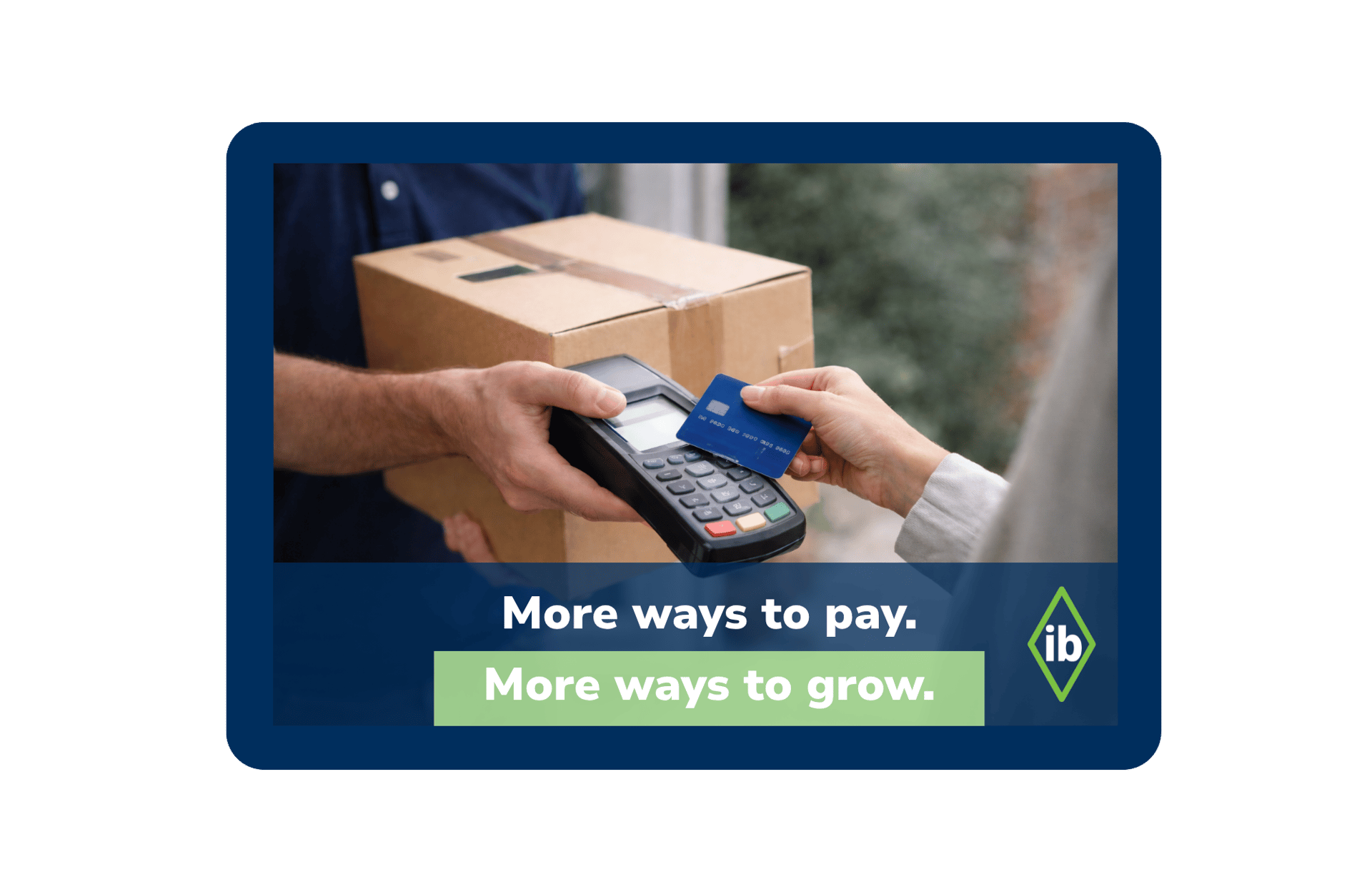
Most orders are paid before they ship. COD moves that to the doorstep. The recipient pays the amount due when the parcel arrives, and USPS handles collecting the money and getting it back to you. That single change touches cash flow, the risk of a refused order, and the reconciliation work on your team’s desk, and it behaves differently by distance, which matters more than usual on a non-continental lane.
What is USPS Collect on Delivery (COD)?
USPS Collect on Delivery (COD) is a postal service that collects the amount due from the recipient as part of delivery. The amount due is what you set for the recipient to pay, which can include the price of the goods and the postage. Merchants use it most often on recurring subscription shipments and on orders where collecting at delivery lowers the risk of not getting paid. USPS publishes the current rules, fees, and limits, and those terms apply to every COD shipment no matter who prints the label.
Which label model fits? Start here
COD runs on two label models. The difference is where payment is collected and how much control you have before the parcel changes hands. The detail follows in the note from our team.
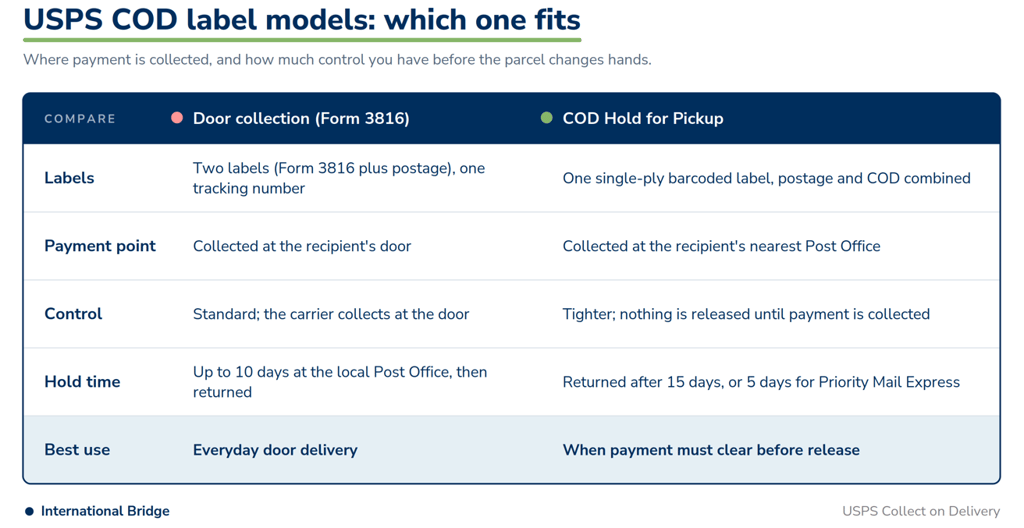
Comparison of the two USPS COD label models across labels, payment point, control, hold, and best use.
Producing the two COD labels: a note from Harry Whitehouse, Chief Innovation Officer
We produce both COD label formats from our software, which is developed in-house. Which format fits an order depends on how much control you want over payment before the parcel is handed over.
Door collection with Form 3816 (two labels)
This model pairs the printed USPS Form 3816 COD form with a standard postage label. Two labels travel on the package, and they share the same tracking number. The carrier attempts delivery at the recipient’s address and collects payment at the door. If the parcel cannot be delivered, USPS holds it at the local Post Office for up to 10 days, unless you designate fewer, then returns it to you.
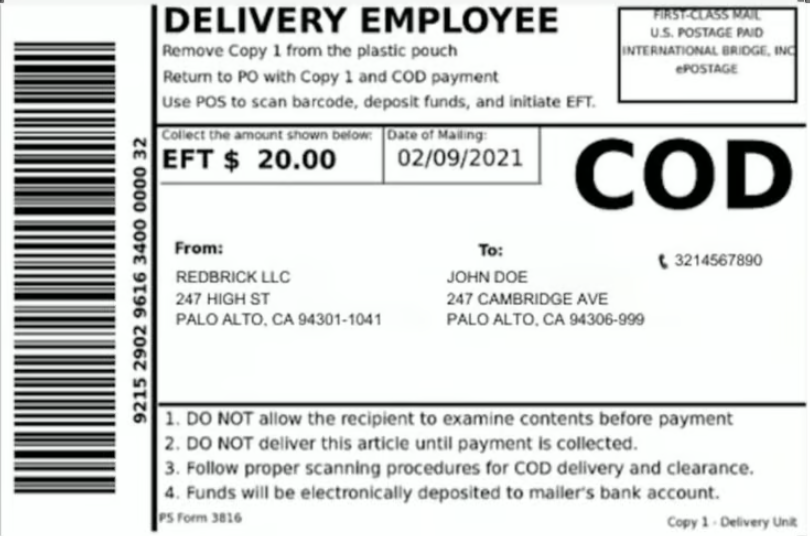
USPS Form 3816 COD label printed alongside the postage label for door collection.
COD Hold for Pickup (single-ply barcoded label)
The second model COD Hold for Pickup, a defined USPS service. It combines the postage and COD form into one single-ply barcoded label and routes the parcel to the recipient’s nearest Post Office. The recipient pays before the package is released, so nothing is handed over until the money is collected. If it is not picked up, USPS returns it to you after 15 days, or 5 days for Priority Mail Express. We generate this format as well, and it gives you the tighter control of the two.
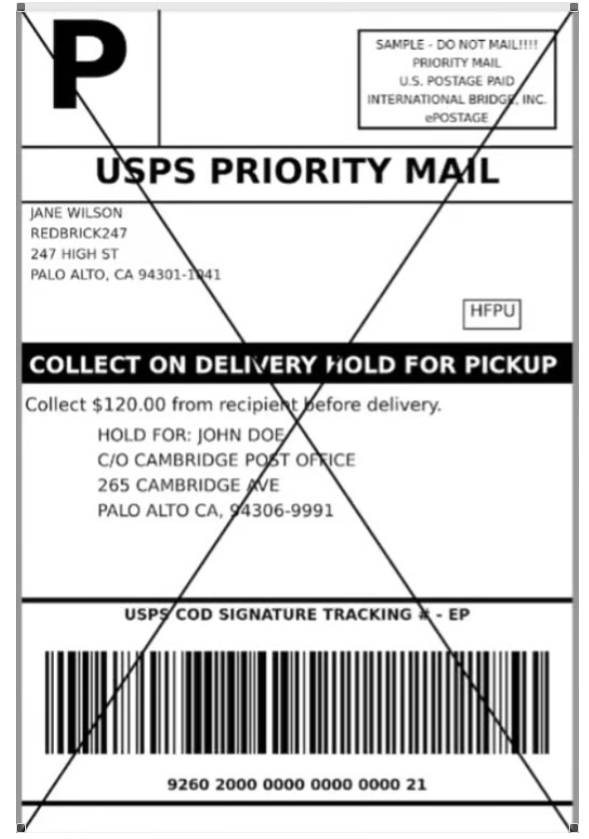
Single combined USPS COD and postage label routed to the recipient's nearest Post Office.
Both formats come off the same system. The order drives the choice.
Payment, fees, and the $1,000 ceiling
Recipients pay by cash or a personal check made payable to the mailer. If they pay cash, USPS converts it to a postal money order and forwards it to you. You pay postage plus the COD fee at mailing, and that fee scales with the amount being collected or the insurance coverage, whichever is higher. The fee carries insurance against loss, rifling, or damage, and against USPS failing to collect or remit on a delivered parcel. USPS caps the amount collected at $1,000 per package, and that ceiling also limits the indemnity USPS will pay.
Getting paid, and setting it up: a note from Marija Vujosevic, Manager, Customer Experience
COD pays out two ways, and the right one depends on your volume. The traditional method mails you a Postal Money Order for each collected payment, which you match to the order and deposit by hand. That works at low volume and gets slow at scale. Electronic Funds Transfer (EFT) replaces it with a consolidated direct deposit and a reconciliation report for each deposit. EFT enrollment is handled through USPS, and our team walks merchants through the setup.
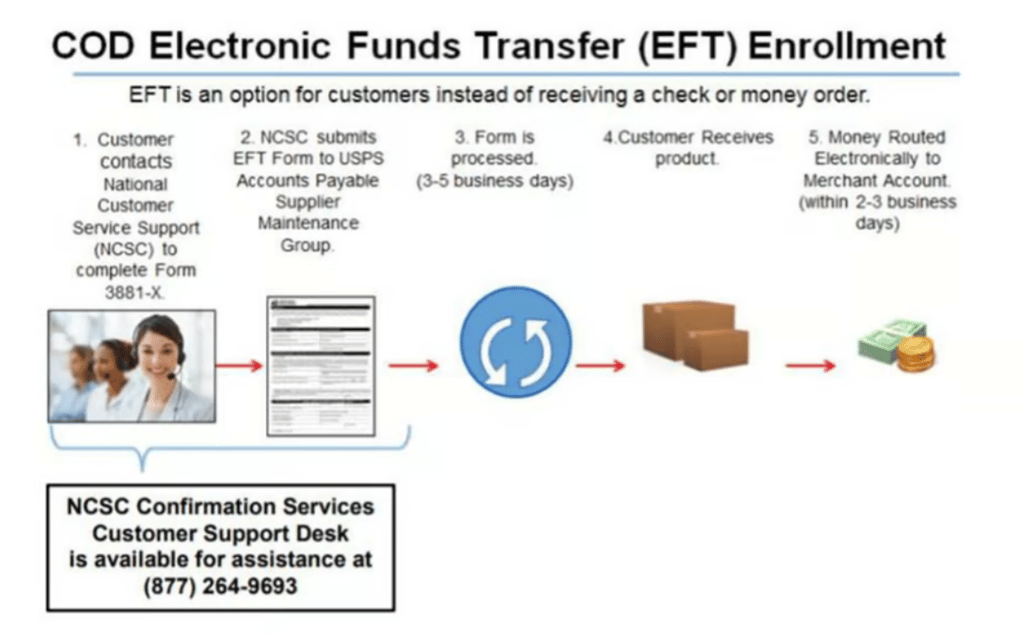
USPS EFT reconciliation report consolidating COD payments into one deposit to the merchant's bank.
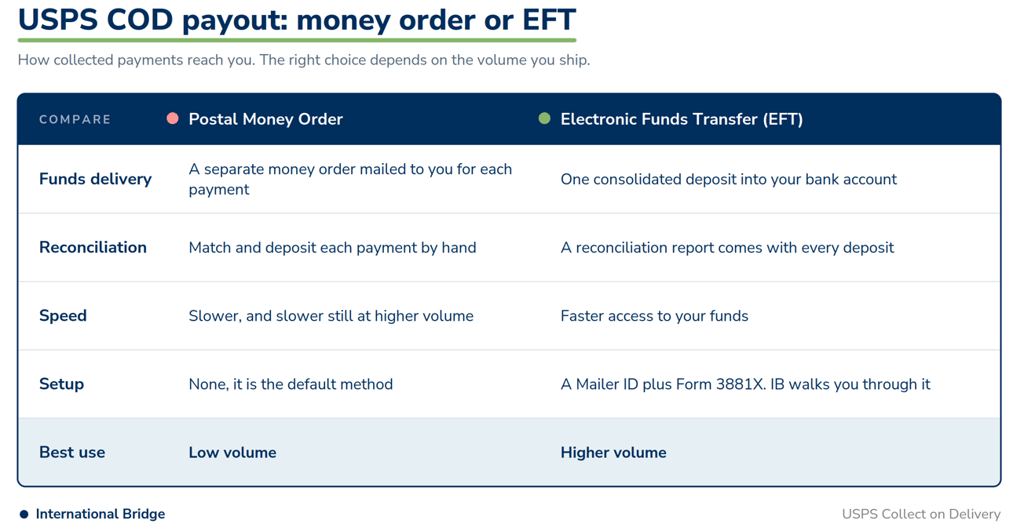
Comparison of Postal Money Order and EFT payout across funds delivery, reconciliation, speed, setup, and best use.
When a COD parcel is refused or goes unclaimed, we manage the return with you. On these lanes, that return covers real distance and cost, and it is easy to overlook until it happens. Choosing the model up front, and reserving COD for the orders that genuinely need payment assurance, is what keeps that exposure contained.
When does COD make sense on a non-continental lane?
COD fits a defined set of situations: subscription shipments, customers who would rather not pay online, orders where payment assurance matters, higher-value goods under the $1,000 limit, and new markets where you do not yet know how a buyer pays. The thread running through all of them is that collecting at delivery lowers the risk of shipping before you are paid.
On non-continental lanes, the math gains a variable. A parcel bound for Hawaii, Alaska, or Puerto Rico travels a long way to reach the recipient. If no one pays, the COD Hold for Pickup parcel is returned to you, and you guarantee the return postage. A refused COD parcel on the mainland US is a short round trip. The same refusal on a non-continental U.S. lane means the parcel covers that distance twice, and you still owe the return leg. On rural routes, common across Alaska, cash or a check are usually the only practical ways a recipient can pay.
One limit worth noting for this audience: USPS COD is not available for APO, FPO, or DPO military addresses, so those orders need a different payment method.
IB has run these lanes for more than two decades, and the pattern holds. COD earns its place here when you reserve it for the orders that genuinely need payment assurance, and when the label model matches the control the order calls for. The definitive guide to shipping to Hawaii, Puerto Rico, and Alaska sets out how the wider network is built across all three.
Keep reading
Definitive guide to shipping to Hawaii, Puerto Rico, and Alaska. The full picture across Hawaii, Alaska, and Puerto Rico, and how each lane is built.
IB Non-Con service overview. How the network is structured and what it is built to handle.
Box of Savings consolidation. The path for small-volume shippers into IB Non-Con’s consolidation economics, which reduce shipping cost by approximately 30% versus standard national carriers.
Frequently asked questions about USPS COD
What is the maximum amount USPS will collect with COD?
USPS caps COD collection at $1,000 per package. The same $1,000 ceiling also limits the indemnity USPS will pay if it fails to collect or remit. For orders above that value, COD is not the right tool, and a prepaid or card-on-file arrangement fits better.
How long does USPS hold a COD parcel that is not delivered or picked up?
It depends on the model. A door-collection parcel that cannot be delivered is held at the local Post Office for up to 10 days, unless you designate fewer. A COD Hold for Pickup parcel is returned to you if it is not collected within 15 days, or 5 days for Priority Mail Express, and you guarantee the return postage in either case.
How does the recipient pay, and how do I receive the money?
The recipient pays by cash or a personal check made payable to the mailer; if they pay cash, USPS converts it to a postal money order. You receive the funds either as that mailed money order or, if you enroll, through Electronic Funds Transfer as a consolidated direct deposit. EFT also provides a reconciliation report for each deposit, which is the practical choice once COD volume is steady.
Does COD cost extra, and what does the fee cover?
Yes, COD adds a fee on top of postage, and the fee scales with the amount being collected or the insurance coverage you select, whichever is higher. That fee includes insurance against loss, rifling, or damage, and against USPS failing to collect or remit on a delivered parcel. USPS publishes the current fee on its price list, so confirm the live figure there before you build it into your pricing.