Shipping to the US Virgin Islands: a setup guide for e-commerce sellers
Shipping from the mainland US to the Virgin Islands requires no USPS customs form, but returns do. Learn how to manage USVI ZIP codes, address validation, EEI filing, and returns with confidence.
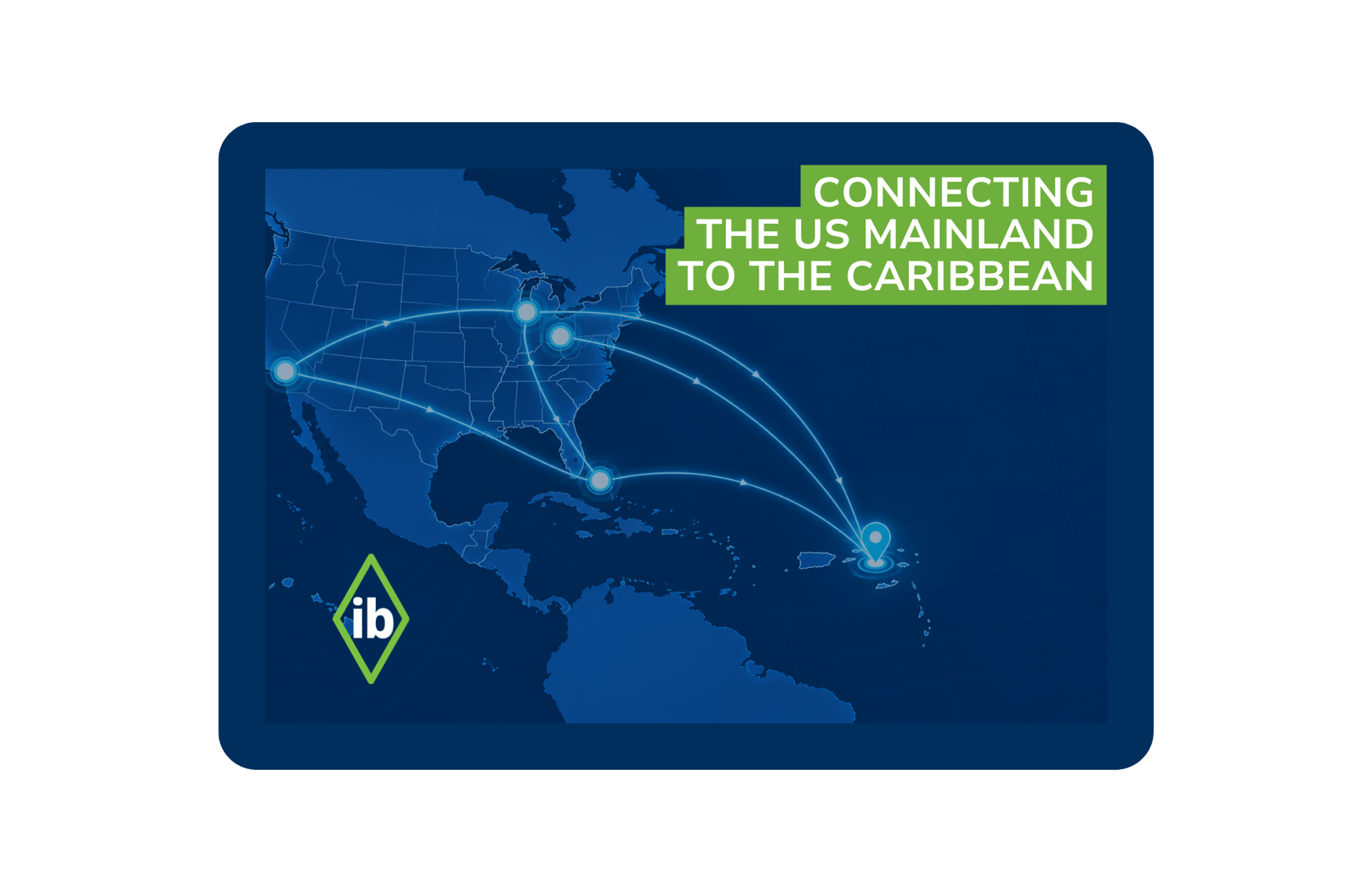
Shipping to the US Virgin Islands (USVI) is domestic for postage and addressing, and the territory sits outside the US customs territory. In the postal stream, a parcel from the mainland US to St Thomas, St Croix, or St John needs no customs declaration. The setup work sits in export filing, territorial import charges, and returns.
The USVI had a population of 87,146 at the 2020 Census. It uses US ZIP codes, the state code VI, and US address conventions.
For more than two decades, International Bridge has specialized in shipping beyond the continental United States, building the network, technology, and operational expertise needed to navigate the unique requirements of Non-Con destinations. The US Virgin Islands are part of our established Non-Con network, where we help e-commerce businesses manage destination-specific shipping requirements, from address validation and label configuration to routing and documentation. What may seem complicated to shippers unfamiliar with the territory is part of our everyday operations.
In this guide, we share that expertise to help retailers understand the specifics of shipping to the USVI and avoid common setup mistakes.
This guide covers the configuration layer for mainland US to USVI orders: valid ZIP codes, address setup, documentation, territorial tax, delivery promises, and returns. Guam follows a different documentation rule, covered in IB's setup guide for shipping to Guam.
For the comparison across all four territories, start with IB's operational guide to shipping to US territories.
Which ZIP codes are valid for the US Virgin Islands?
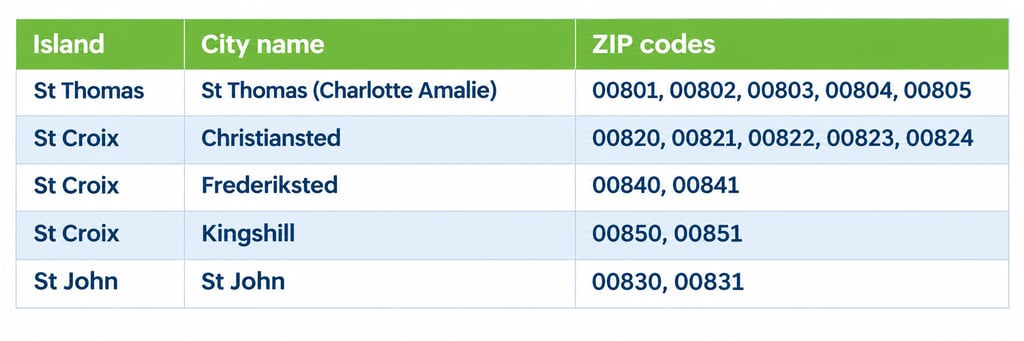
The US Virgin Islands has 16 assigned ZIP codes, all beginning 008. No other US destination uses that prefix, so it works as a first filter. A rule that accepts the full 00801 to 00851 range still accepts 35 codes that do not exist, so validate against the explicit list.
 Some USVI customers receive mail only at a PO Box. A checkout that blocks PO Box addresses turns those customers away, a pattern covered in IB's guide to shipping to PO Boxes.
The reliable approach is an allowlist of the 16 codes, validated together with the VI state code.
How should a USVI address be configured?
In postal addressing, a USVI address is a US destination with VI in the state field and United States as the country. Many e-commerce platforms also list the US Virgin Islands as its own country, under the ISO code VI. When the two models meet in one order flow, the order can be routed as international and pick up customs data and pricing it does not need.
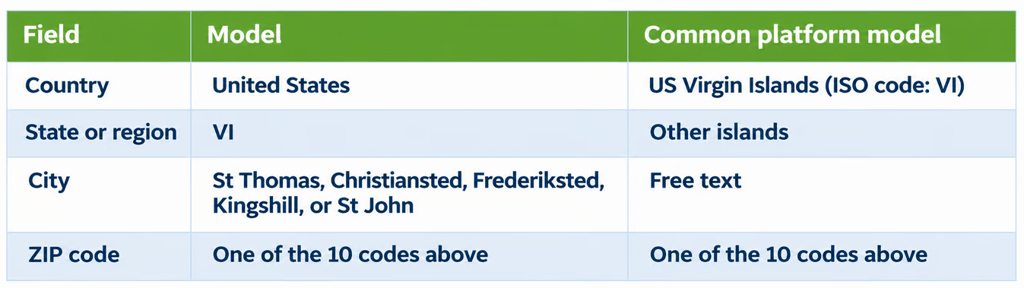
Map the destination for each system in the stack, then test one order end to end, from checkout to label.
The street line needs its own check. USPS Publication 28 recognizes estate names in USVI addresses, and lot or plot numbers are not normally part of a standardized primary address line. Validate against USPS-compatible USVI address formats, and test with real USVI addresses before go-live.
Does a USVI parcel need a customs form?
A parcel from the mainland US to the USVI needs no customs declaration in the postal stream.
Domestic Mail Manual 608.2.3 requires a PS Form 2976 (CN 22) or PS Form 2976-A (CP 72) on mail sent from the United States, Puerto Rico, or the US Virgin Islands to a listed set of ZIP codes. That list covers the Pacific territories and the Freely Associated States, and no USVI code is on it.
This is where territory logic copied from Guam goes wrong. A label rule that generates a declaration for every territory adds a step the postal stream does not require for the USVI. Set the rule by destination: a declaration at 16 ounces or more for Guam, American Samoa, and the Northern Mariana Islands, and none for the USVI.
Shipping providers outside the postal stream set their own policies, and some handle the USVI as an international destination with full customs data. Confirm the documentation rule with each provider in your setup. The absence of a USPS customs declaration does not remove territorial customs clearance or import charges, covered below.
What taxes and charges may apply when goods arrive in the USVI?
The USVI has no general sales tax, but goods arriving in the territory may be subject to excise tax or customs duties depending on their origin, intended use, and product classification. US-origin goods generally qualify for duty-free entry, while foreign-origin goods may face territorial customs duties.
The Virgin Islands Bureau of Internal Revenue (BIR) administers excise tax, and personal imports may also require clearance through its online excise portal. A commercial invoice with clear item descriptions and values shortens that clearance.
Before deciding what to disclose or collect at checkout, establish which charges apply to your product categories and which party is responsible for them. Then state that clearly in the checkout and order confirmation.
What happens when a USVI customer returns an order?
Returns from the USVI need more setup than the outbound order. USPS requires a computer-generated customs declaration on goods mailed from the USVI into the US customs territory, regardless of weight or mail class. A prepaid return label built from a mainland US template may not carry one.
The current requirements sit in the July 30, 2026 amendment to DMM 608, published in the Federal Register as an interim final rule. The online manual may still show the older numbering. Under the amendment, the customs information includes item descriptions, quantities, values, weights, tariff classifications, and country of origin. Covered shipments may also require proof of applicable duty payment or exemption before acceptance at a Post Office retail counter.
For a seller, that changes three things:
The return label needs a customs declaration with item descriptions, quantities, values, weights, tariff classifications, and country of origin.
Return instructions need to reflect how covered items are presented for mailing, including any proof of duty payment or exemption.
The returns policy needs to say who handles any duty payment or exemption paperwork.
Verify the applicable process against the current rule text before issuing prepaid returns or publishing customer instructions. The comment period closed on August 31, 2026, and the rule may be amended.
How should delivery promises be set for USVI orders?
Time-sensitive e-commerce parcels to the USVI move on established air routes, the model described in the full non-con delivery framework. Ocean freight serves large cargo on longer timelines. Build the delivery promise from a confirmed, service-specific transit estimate for the USVI lane.
The USVI runs on Atlantic Standard Time (UTC-4) and does not observe daylight saving time. While the mainland US is on standard time, the USVI is one hour ahead of US Eastern time. During daylight saving time, the two match.
Set order cutoffs and promise dates against local USVI time, and use the window for this lane in the delivery promise.
How does the USVI compare with Guam and Puerto Rico?
The USVI shares Puerto Rico's outbound documentation profile and Guam's customs status. That combination is why a single "territory" rule fails on at least one of the three.
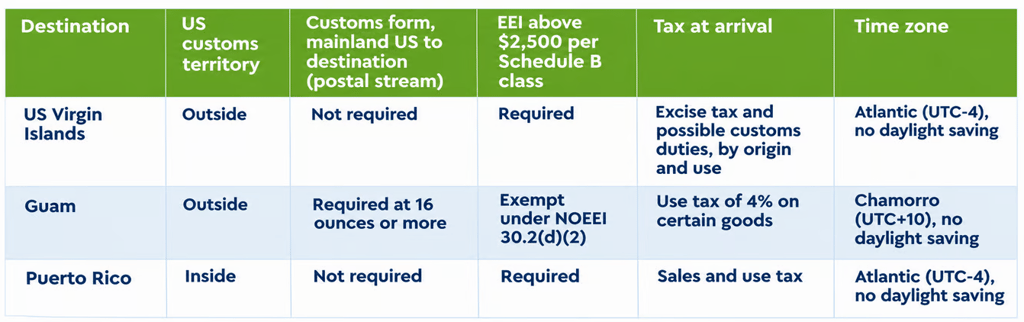
What breaks most often on a USVI shipment?
Most USVI failures start in configuration, at checkout or at label time, and each has a direct fix.
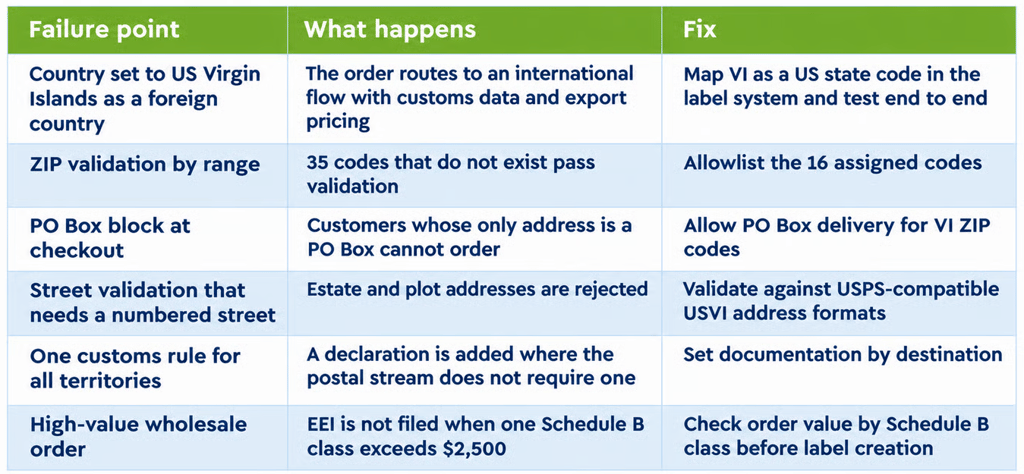
Most configuration errors occur before a parcel leaves the mainland.
Returns introduce a different challenge: shipments traveling from the USVI back to the mainland require customs documentation that outbound postal shipments do not.

USVI shipping checklist for e-commerce sellers
Allowlist the 16 USVI ZIP codes and extend rate tables to cover them.
Confirm how your platform and your label system each represent the USVI, and test one order end to end.
Allow PO Box and estate-style addresses for VI ZIP codes.
Set customs declaration rules by destination, with none for mainland US to USVI parcels in the postal stream.
Flag orders where one Schedule B class exceeds $2,500 for EEI filing.
Establish which import charges apply to your product categories and who pays them, then decide what the checkout says.
Set cutoffs and delivery promises against Atlantic Standard Time, using a confirmed, service-specific transit estimate for the lane.
Build a USVI return flow with a customs declaration, counter-drop instructions, and a stated duty policy.
How IB handles the USVI
International Bridge has operated non-continental lanes for more than two decades, and the USVI runs as a standard lane on the IB Non-Con network.
IB's software, developed in-house, applies documentation by destination at label creation. USVI parcels follow the standard domestic flow with no postal-stream declaration, and declarations generate where the destination requires them. IB's team configures the destination rules with the seller.
For lower-volume shippers, Box of Savings provides access to the same network.
Frequently asked questions
Is shipping to the US Virgin Islands domestic or international?
Shipping to the US Virgin Islands is domestic for postage and addressing, and the territory sits outside the US customs territory under 19 CFR 7.2. It uses US ZIP codes beginning 008 and the state code VI. In the postal stream, mainland US parcels need no customs form, while EEI filing and territorial import charges can still apply.
Does a package to the USVI need a customs form?
A package from the mainland US to the USVI needs no customs form in the postal stream. DMM 608.2.3.1 lists the ZIP codes that require a CN 22 or CP 72, and no USVI code is on it. Other shipping providers set their own rules, and returns from the USVI to the mainland US need a declaration.
When is EEI filing required for a USVI shipment?
EEI filing is generally required for a mainland US to USVI shipment when one Schedule B class of goods is valued at more than $2,500, under DMM 608.2.4.1 The Guam exemption, NOEEI 30.2(d)(2), does not cover the USVI. Some shipments require filing regardless of value, so check the mandatory triggers as well as the threshold.
Do sellers collect sales tax on orders to the USVI?
The USVI has no general sales tax, so there is no sales tax to collect on orders shipped there. Goods arriving in the territory may still face excise tax or customs duties depending on origin, use, and product classification. Establish which charges apply and who is responsible before deciding what to disclose or collect at checkout.
Talk to IB about your USVI setup
A conversation covers the specific items in this guide: how your rate tables and address validation handle the 16 USVI ZIP codes, how the USVI is represented across your platform and label system, where EEI filing applies to your order profile, and how your return flow handles the customs declaration. No commitment is required to review the setup.
Contact the International Bridge team
If you want more context first
Shipping to US territories: an operational guide for retailers. The cluster lead, comparing customs treatment across Guam, the USVI, American Samoa, and the Northern Mariana Islands.
IB Non-Con. How the network handles routing and documentation for every destination outside the mainland US.
Box of Savings. How lower-volume shippers reach the same lanes through consolidation.