Shipping to Guam: a guide for online sellers
Guam uses US ZIP codes and sits outside the US customs territory. This guide covers the configuration layer for mainland US to Guam orders: which ZIP codes are valid, what documentation applies, and how to set a delivery promise.
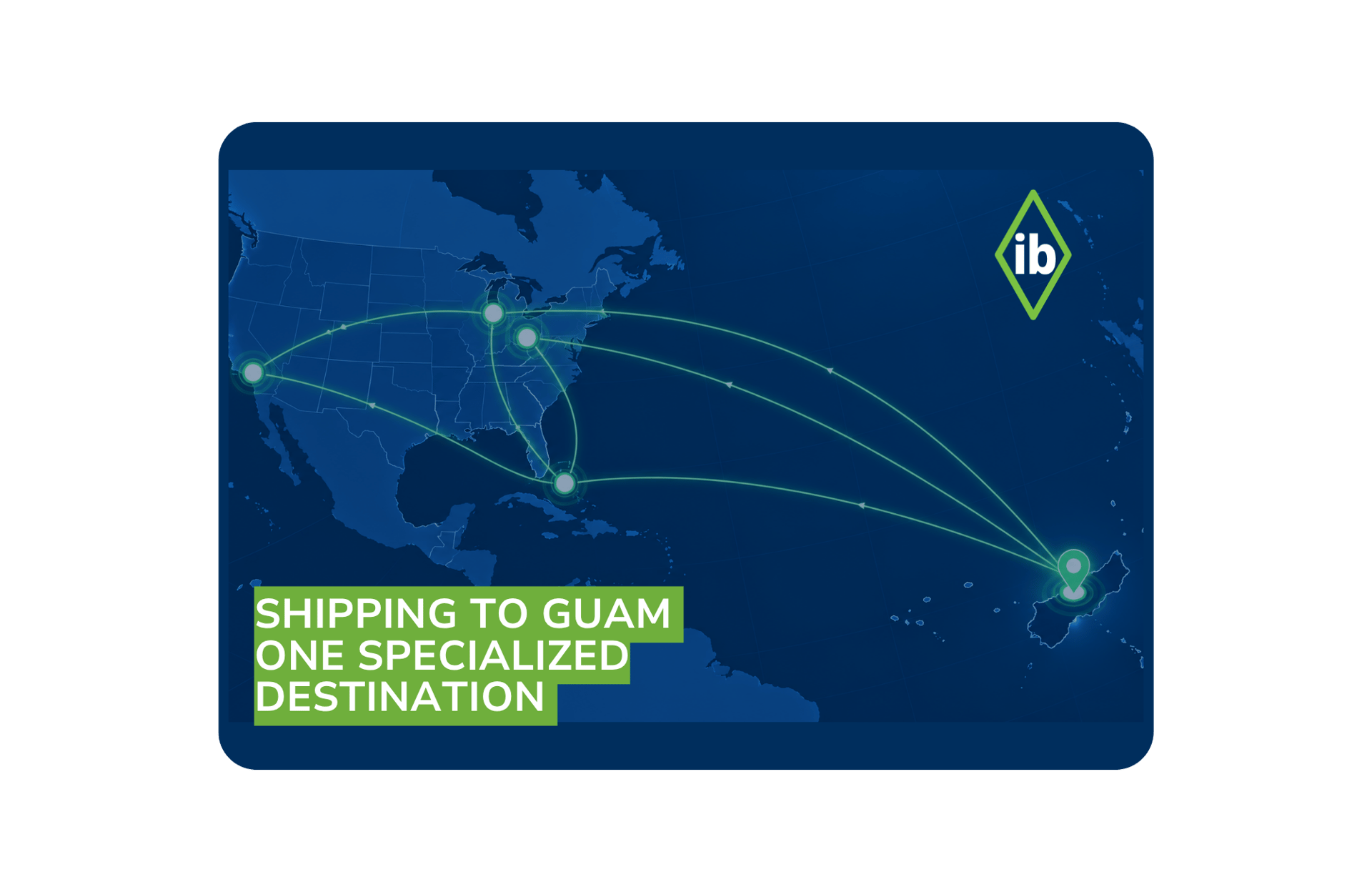
Guam orders commonly fail in two ways. Some systems treat Guam as a foreign country and block it at checkout. Others treat it as an ordinary domestic ZIP code and miss the documentation that applies to the lane.
At International Bridge, managing these requirements is part of everyday operations. With more than two decades of experience in non-continental shipping, IB helps e-commerce sellers navigate Guam's specific shipping requirements through an established network and purpose-built technology.
Guam is a US territory in the Western Pacific with a population of 153,836 at the 2020 Census. It uses US ZIP codes, the region code GU, and US address conventions. It also sits outside the customs territory of the United States under 19 CFR 7.2, so Guam administers its own customs operations through the Guam Customs and Quarantine Agency.
This guide covers outbound orders from the mainland US to Guam. Shipments in the other direction, from Guam into the fifty states, Washington DC, and Puerto Rico, changed in 2026 and are outside the scope here. For the wider view across all four territories, start with IB's operational guide to shipping to US territories, then come back for the Guam detail.
Which ZIP codes are valid for Guam?
Guam has thirteen assigned five-digit ZIP codes. They are not a continuous range, so a rule that accepts everything between the lowest and the highest will accept codes that do not exist.
96910, 96912, 96913, 96915, 96916, 96917, 96919, 96921, 96923, 96928, 96929, 96931, 96932
The 969 prefix is also no shortcut. It covers four other destinations, three of which are foreign for trade purposes.
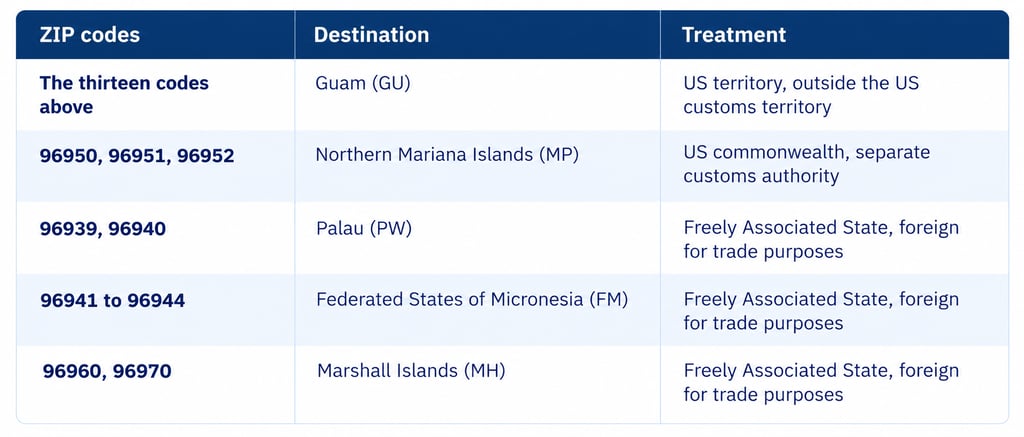
The three Freely Associated States count as domestic mail for postage but are foreign destinations under the Foreign Trade Regulations, and some items sent there require an export license. A rule that sweeps them in with Guam will eventually produce a shipment nobody intended to send.
The reliable approach is an explicit allowlist of the thirteen codes, validated together with the GU region code.
How should a Guam address be configured?
In postal and carrier addressing, Guam is handled as a US destination with GU in the state or region field and the country as United States. E-commerce platforms do not all use that model. Several treat Guam as its own entry in the country list, which means the same order can be structured two different ways depending on where in the stack it sits.
The practical instruction is therefore to map Guam correctly for each system and test the result end to end, rather than applying one country value everywhere. A mismatch between the platform's model and the carrier's model is what pushes a Guam order into an export flow it does not need.
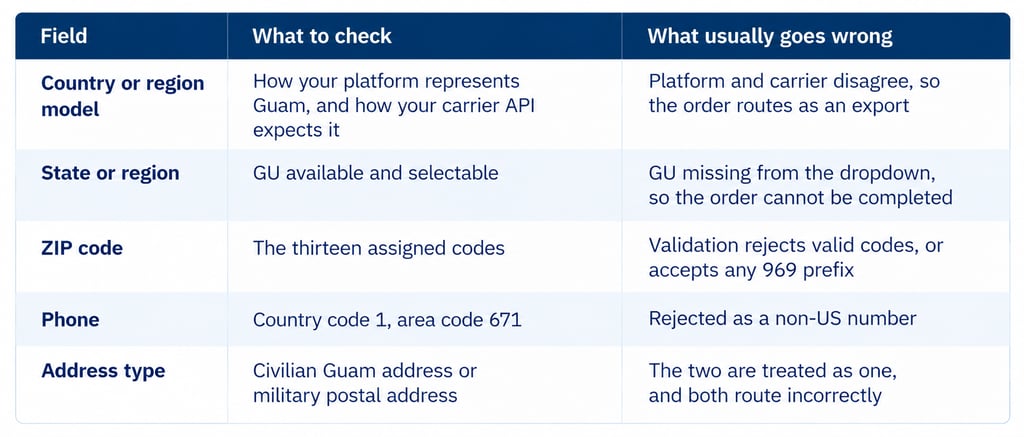
On that last row: a street address on a military installation in Guam is still a civilian-format Guam address and is handled as one. Military postal routing applies when the address itself is in APO, FPO, or DPO format, which follows a separate framework.
Why do Guam orders get blocked or surcharged?
Most Guam checkout blocks are configuration rather than policy. Rate tables built around the contiguous US return no rate for a Guam ZIP code. When no rate returns, the default platform behavior is to hide the shipping option. The customer sees a destination the store does not serve, when the store never made that decision.
The surcharge path is the same problem with a different outcome. Where a rate does return, it is often an exception rate priced at the top of the zone ladder. Volume on any single mainland US to territory lane is small, and carriers without an existing non-continental network price these lanes accordingly.
What customs documentation does a Guam parcel need?
In the postal stream, a parcel sent from the mainland US to Guam requires a customs declaration once it weighs 16 ounces or more, regardless of what it contains. The standard sits in Domestic Mail Manual 608.2.3.1. The declaration is PS Form 2976, the CN 22, or PS Form 2976-A, the CP 72, and it must be computer-generated with the customs data transmitted electronically.
Two qualifications matter:
The rule has exceptions. Items sent via Priority Mail Express, or Priority Mail combined with Registered Mail service, fall outside the 16-ounce requirement.
Carriers operating outside the postal stream set their own documentation policies, and several require a declaration on every Guam parcel regardless of weight.
A parcel deposited without a properly completed form is returned to the sender under 608.2.3.2. That subsection was renumbered from 2.3.3 by an amendment effective 30 July 2026, so older references and some published pages still carry the previous number.
A return is the failure worth designing against, because it consumes the original shipping cost and the customer relationship together.
Complete the tariff code on the declaration. It classifies the goods for the receiving customs authority. The manual sets out an explicit mandatory data element list, including Harmonized Tariff Schedule codes, for items sent into the US customs territory. For outbound parcels to Guam, treat the code as part of a properly completed form and confirm the requirement with your carrier.
One requirement that does not apply on this lane: electronic export filing. Goods shipped from the mainland US to Guam are exempt regardless of value, under exemption code NOEEI 30.2(d)(2).
What changed for shipments leaving Guam?
Sellers who also move goods from Guam into the fifty states, Washington DC, or Puerto Rico should know that this direction changed. Duty-free de minimis treatment was suspended globally with effect from 29 August 2025. In June 2026 Customs and Border Protection published an interim final rule suspending the de minimis exemption for merchandise arriving through the postal network. A new informal entry process followed, effective 24 July 2026.
An interim final rule from the Postal Service then took effect on 30 July 2026, adding customs clearance and duty prepayment procedures to Domestic Mail Manual 608. They cover goods mailed from Guam, American Samoa, the Northern Mariana Islands, and the US Virgin Islands into the US customs territory.
In outline, a mailer sending dutiable goods valued up to $2,500 pays the applicable duties, taxes, and fees before mailing. The mailer then presents proof of payment or of exemption at a retail counter, and the acceptance employee links that record to the tracking number. Items covered by the procedure cannot be deposited or collected through the usual pickup methods. Items containing only documents with no monetary value are outside it.
This is an interim final rule, and the comment period closed on 31 August 2026. Anyone shipping in that direction should work from the current rule text rather than from summaries, and check whether it has been amended since.
What taxes or fees may apply to Guam shipments?
Guam operates outside the US customs territory and has its own import requirements. A use tax of four percent may apply to certain goods brought into Guam, under Chapter 28 of Title 11 of the Guam Code Annotated. Exemptions depend on the goods and on the circumstances of the importer.
For a seller the practical step is narrow. Confirm how the tax treats your product category, then decide what to tell the customer at checkout. Setting that expectation in advance costs less than handling it after delivery.
How long does shipping to Guam take?
Time-sensitive e-commerce parcel services to Guam rely on air transportation. Ocean transit serves large cargo such as vehicles and furniture, with transit times measured in weeks. On IB's non-continental network, the published transit window to Guam runs 6 to 8 business days.
Time zone arithmetic catches sellers out. Guam runs on Chamorro Standard Time at UTC+10 and does not observe daylight saving. That puts it 14 to 18 hours ahead of mainland US time zones, depending on the zone and the season. For most of the mainland US business day, Guam is already on the following calendar date, so cutoffs and promise dates should be set against local Guam time.
What breaks most often on a Guam shipment?
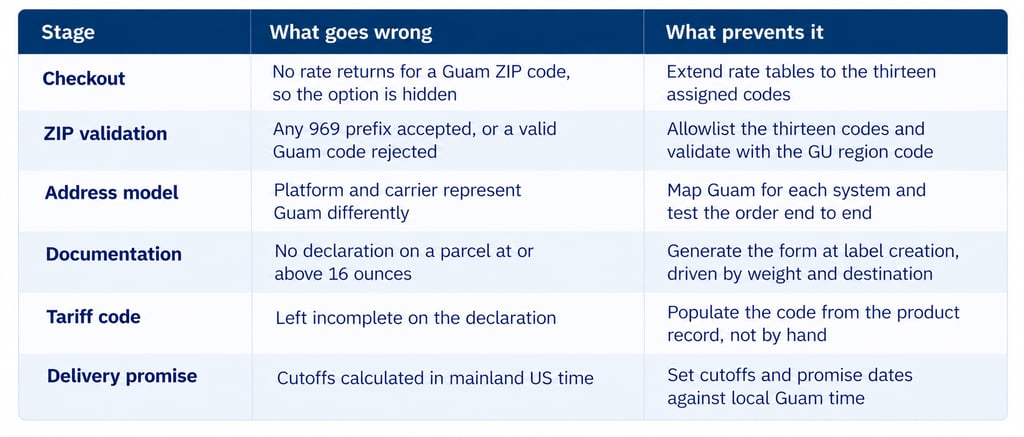
Guam shipping checklist for e-commerce sellers
Allowlist the thirteen Guam ZIP codes in validation, and extend rate tables to cover them
Confirm how your platform and your carrier API each represent Guam, and test one order end to end
Check what your United States shipping setting actually includes before assuming Guam is served
Configure the label system to generate a customs declaration by weight and destination, with the tariff code populated from the product record
Confirm how Guam's use tax treats your product category, and decide what the checkout will say about it
Set order cutoffs and delivery promises against local Guam time, using the window for the lane rather than a regional average
If you also ship from Guam into the fifty states, DC, or Puerto Rico, review the 2026 duty prepayment procedures separately, working from the current rule text
How IB handles Guam
International Bridge operates a non-continental network with two decades of operating history on these lanes. Lane density is what allows a destination like Guam to run as part of standard operations rather than as an exception. That is the difference between an exception rate and a built lane.
On the documentation side, IB's software, developed in-house, generates the customs declaration at the same point it generates the shipping label, applying the requirement by destination and weight. The logic sits inside the shipping platforms a seller already runs, so declaration handling does not become a manual back-office task at volume.
For sellers new to territory shipping, the documentation question is the part that most often stalls the build. The capability is built into IB Non-Con, and IB's team configures the destination logic with the seller rather than handing over a specification. With the right setup and support, shipping to Guam becomes a manageable part of serving customers beyond the contiguous US.
Frequently asked questions
Is shipping to Guam domestic or international?
Shipping to Guam is domestic for addressing and postage purposes and foreign for customs purposes. Guam uses US ZIP codes, the region code GU, and standard US address formats. It sits outside the US customs territory under 19 CFR 7.2 and runs its own customs authority. That is why a declaration applies where a mainland US order would need none.
Which ZIP codes belong to Guam?
Guam has thirteen assigned ZIP codes: 96910, 96912, 96913, 96915, 96916, 96917, 96919, 96921, 96923, 96928, 96929, 96931, 96932. They are not a continuous range. Other codes beginning 969 belong to the Northern Mariana Islands, Palau, the Federated States of Micronesia, and the Marshall Islands, which have different customs and trade treatment.
Does a shipment to Guam require a customs declaration?
In the postal stream, yes, once the parcel weighs 16 ounces or more, under Domestic Mail Manual 608.2.3.1. Priority Mail Express and Priority Mail with Registered Mail service fall outside that requirement. Carriers outside the postal stream set their own policies, and several require a declaration on every parcel, so generating documentation at label creation is the safer default.
Is Guam included in a United States shipping setting?
Not always. Many platforms apply a United States shipping setting to the contiguous states only, with Hawaii, Alaska, Puerto Rico, and the territories handled as exceptions or excluded entirely. Check what the setting covers in each rate table, and confirm how your platform represents Guam, before assuming the destination is served.
Talk to IB about your Guam setup
A conversation covers the specific items in this guide. How your rate tables handle the thirteen Guam ZIP codes. How Guam is represented across your platform and your carrier connection. What documentation generates at label creation, and at what weight. What the transit window supports as a delivery promise. No commitment is required to review the setup.
Contact the International Bridge team
If you want more context first
Shipping to US territories: an operational guide for retailers. The cluster lead, covering Guam, USVI, American Samoa, and CNMI together, with customs treatment compared across all four.
The definitive guide to shipping to Hawaii, Puerto Rico, and Alaska. The architectural view of how non-continental lanes are built.
IB Non-Con. How a purpose-built non-continental network handles consolidation, air routing, and documentation across every destination outside the contiguous US.
Sources
Customs territory status: 19 CFR 7.2, with supporting context in GAO-26-107811
ZIP assignments, the 16-ounce threshold and its exceptions, the return-to-sender standard, and the NOEEI 30.2(d)(2) exemption: Domestic Mail Manual 608
Note that the published manual page may still display the pre-amendment subsection numbering. The renumbering is set out in the 30 July 2026 amendment
Outbound duty prepayment procedures effective 30 July 2026: Duty Collection for Domestic Mail Arriving From Certain Insular Possessions and Territories, 91 FR 47960
De minimis suspension and the postal informal entry process: CBP interim final rule, 91 FR 37801
Population: US Census Bureau, 2020 Census counts for Guam
Transit window and network detail: International Bridge, shipping to US territories operational guide